
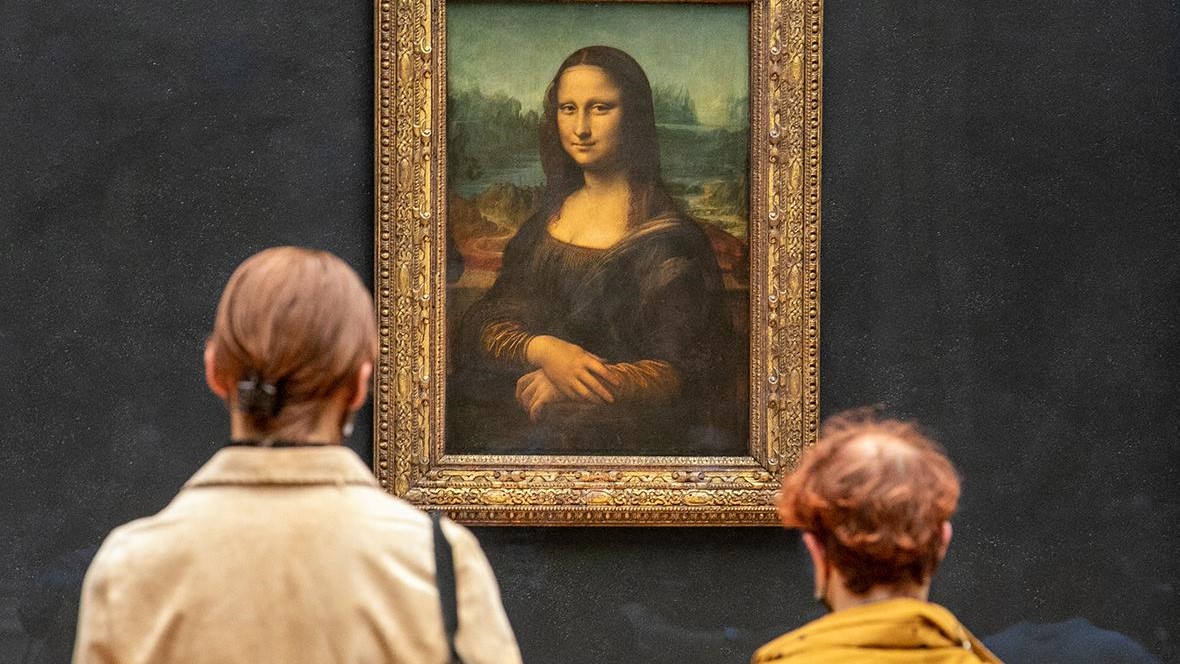
The smile lasts four centuries and still refuses to explain itself. Leonardo da Vinci finished the portrait around 1517, yet every year millions stand in front of the small poplar panel and leave with more questions than answers. The painting hangs behind bullet-proof glass in the Salle des États, protected like a state secret, and for good reason.
First, the background refuses to stay still. Look long enough and the landscape behind Lisa Gherardini seems to shift. Mountains on the left sit lower than those on the right, rivers appear to flow uphill, and the horizon line breaks every rule of linear perspective that Leonardo himself wrote about. Art historians spent decades arguing whether he did it on purpose. Recent scans using X-ray fluorescence show he painted and repainted the same areas up to thirty times, far more than in any other work. He was searching for something he never quite found.
Then there is the question of the eyebrows. Early copies made while Leonardo was still alive show faint traces of them. The original today has none. Acid cleaning in the 19th century is usually blamed, but a 2007 high-resolution photograph revealed microscopic dots of pigment where brows should be. Someone shaved them off deliberately, perhaps centuries ago, perhaps to make her look more modern, perhaps for reasons we will never know.
The biggest puzzle remains her expression. In 2005, software developed at the University of Amsterdam analyzed the curve of her mouth and the direction of her eyes. The program concluded she is 83 percent happy, 9 percent disgusted, 6 percent fearful, and 2 percent angry. Those numbers became famous, but they miss the point. The smile changes depending on where you look. Focus on the eyes and the mouth seems neutral; focus on the mouth and it turns upward. Leonardo used a technique he called sfumato—smoke without lines—so the edges dissolve just enough for your brain to fill in the rest. The mystery is not in the paint. It is in you.